
by Lydia Reeder
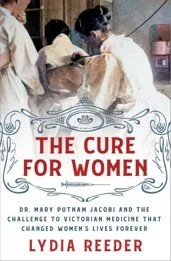
Sometimes it is easier to talk about a difficult subject by talking about what is happening somewhere else in the world or by talking about what happened during a different time period. For those of you who want to talk about reproductive healthcare, I recommend this book: The Cure for Women.
How Victorian male doctors used false science to argue that women were unfit for anything but motherhood—and the brilliant doctor who defied them
After Elizabeth Blackwell became the first woman to graduate from medical school, more women demanded a chance to study medicine. Barred entrance to universities like Harvard, women built their own first-rate medical schools and hospitals. Their success spurred a chilling backlash from elite, white male physicians who were obsessed with eugenics and the propagation of the white race. Distorting Darwin’s evolution theory, these haughty physicians proclaimed in bestselling books that women should never be allowed to attend college or enter a profession because their menstrual cycles made them perpetually sick. Motherhood was their constitution and duty.
Into the midst of this turmoil marched tiny, dynamic Mary Putnam Jacobi, daughter of New York publisher George Palmer Putnam and the first woman to be accepted into the world-renowned Sorbonne medical school in Paris. As one of the best-educated doctors in the world, she returned to New York for the fight of her life. Aided by other prominent women physicians and suffragists, Jacobi conducted the first-ever data-backed, scientific research on women's reproductive biology. The results of her studies shook the foundations of medical science and higher education. Full of larger than life characters and cinematically written, The Cure for Women documents the birth of a sexist science still haunting us today as the fight for control of women’s bodies and lives continues.
Idahoans United for Women and Families collected more than 110,000 signatures for the ballot initiative. The Reproductive Freedom and Privacy Act will be on the Idaho ballot this fall. The initiative would legalize abortion until fetal viability or in cases of emergency–essentially re-establishing the abortion rights Idahoans had before the U.S. Supreme Court overturned the Roe v. Wade decision four years ago. The initiative would also enumerate rights related to reproductive health, such as protections for access to contraception and IVF, and privacy in medical decisions.
Abortion is a morally complex issue, no doubt about it. Should we talk about it as a church? I believe the answer is YES. After you read A Cure for Women, you might revisit the ELCA’s 1991 Social Statement: Abortion and accompanying study guide. Wartburg College professor Caryn Riswold’s ReEngaging ELCA Social Teaching on Abortion is a wonderful small book that looks at all that has changed since 1991 and ends with a variety of pastoral letters to readers. The ProVoice Project has collected the stories of women seeking reproductive healthcare and stories of the doctors caring for them. Abortion as healthcare is an intersectional issue, so you can add in our ELCA Social Statements on Economic Life; Healthcare; and Faith, Sexism, and Justice.