
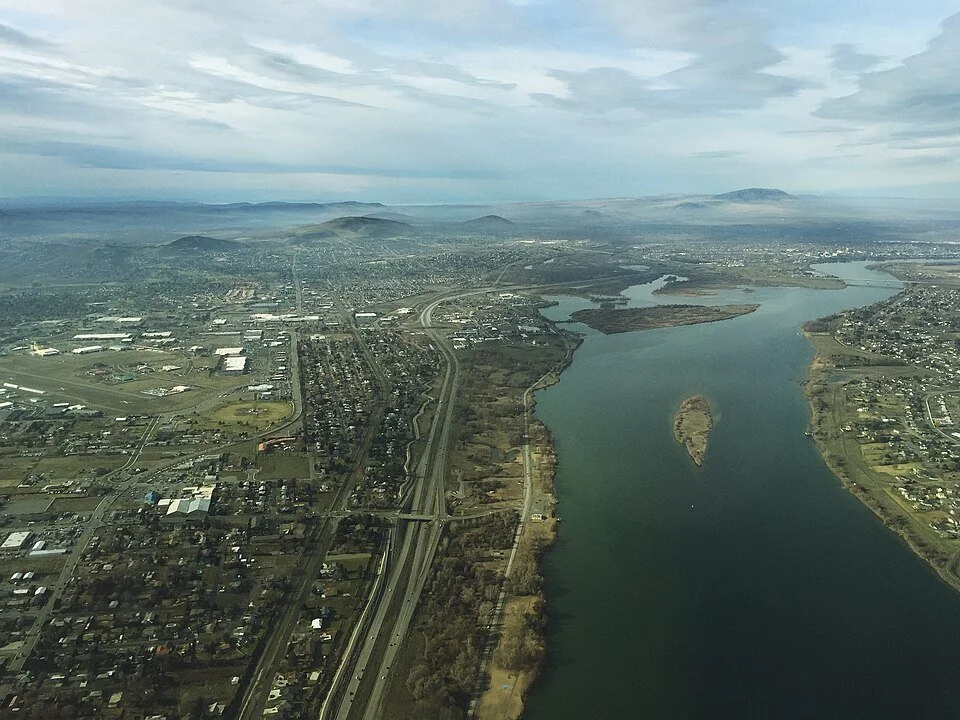
By formulanone from Huntsville, United States - Kennewick-ColumbiaRiverAerial, CC BY-SA 2.0, https://commons.wikimedia.org/w/index.php?curid=74639077
A featured article by Liv Larson Andrews
I grew up near the banks of the mighty Mississippi. Because my mother hailed from Mankato, Minnesota and longed to see her family, we would drive much of the “avenue of the saints” between St. Louis and St. Paul every summer. And we always stopped in Hannibal, Missouri. Because of its history? No. Because it was Mark Twain’s hometown? Nope. It was because the McDonalds near the interstate featured a playground, and my mother was making this summer trip solo, with me and my younger brother in tow. For her sake I hope they had decent coffee.
I’ve heard Phil Misner introduce our synod as “a synod marked by rivers.” I couldn’t agree more. The land we call the NWIM synod is linked, divided, nourished, drained, and defined by its rivers. Imagine how blessed I felt recently to stumble across a piece of writing from Mark Twain’s Life on the Mississippi titled “Two Ways of Seeing a River.” Twain reflects on the gains and losses he experienced in learning to navigate the river as a riverboat pilot. Gains, and losses. He essentially says that the wonder and beauty of the river which once entranced him, as he remarks about a particular sunset, “I stood like one bewitched. I drank it in, in a speechless rapture. The world was new to me, and I had never seen anything like this at home,” comes to be lost to him once he can read the river for potential dangers and snags. “But as I have said, a day came when I began to cease from noting the glories and the charms which the moon and the sun and the twilight wrought upon the river's face; another day came when I ceased altogether to note them.”
Have you ever experienced this? You become deeply involved or educated about something and the spark of wonder that initially drew you to it seems to fade. Gains and losses. It’s a sobering thought. And yet I’m reminded of the many indigenous voices who have also offered, “a river is never the same twice. It is always changing.” In fact, there are infinite ways of seeing a river. And perhaps they can all exist at the same time. Certainly, they all exist in the wide reality of the Creator’s abundant love. Rivers can be just about anything. And so can ministry.
Ministry, in all the ways we live it—parish, hospital, campus, new/old projects, organizing, public service and public witness—has its seasons just like a river does. It’s up; it’s down. It bends unexpectedly. It has snags. It dwindles to a trickle or rages in a torrent of energy. When we are so focused on navigating the moment-to-moment challenges, we easily miss the glorious sunset. Too homed in on that potential snag we know is coming, or worried about our own lack of knowledge (gosh…never floated this section before…), we fail to look up from our wheel, our desk, our phone, our whatever and just see. Oh, my goodness: the play of the twilight sun on the water!
The best part of this, NWIM friends, is that the very thing we would note as a risk or a trial or a snag along our river journey is also something to be seen from many angles. Two ways of seeing a closure. Two ways of seeing a pastoral vacancy. And if we receive the river’s wisdom, it’s never the same challenge moment to moment. New possibilities emerge continually. Can we see them?
Very soon, many of us from around the synod will gather along the banks of the mighty Columbia for an in-person synod assembly. Alleluia! Thinking back to my childhood, I will be thinking about the many roadways you will take to join us in the Tri-Cities as another kind of “avenue of the saints.” The saints who will gather to be the church together. Thank you for that gift of time and embodiment. Thank you for the ways you have seen the river—both the literal waterways of our geography and the metaphorical, baptismal streams of life and ministry among us.
May the light on the water always dazzle us.
Liv