Dear Friends in Christ,
Thursday night I had the pleasure of hearing scientist, mother, decorated professor, author, and enrolled member of the Citizen Potawatomi Nation Robin Wall Kimmerer speak at Boise State’s Morrison Center as part of Boise’s The Cabin’s Readings Conversations series. I read Kimmerer’s Braiding Sweetgrass: Indigenous Wisdom, Scientific Knowledge and the Teachings of Plants a few years ago. I remembered being grateful for the ways Kimmerer seamlessly wove together Western science, Indigenous wisdom, and her own lived experiences. During my Jesuit Volunteer Corps year after college, I lived and worked in Syracuse, NY, where Kimmerer lives, and so I also loved reading about familiar places.
It was timely to hear Kimmerer speak so close to Holy Trinity Sunday, when many of us will hear the beautiful creation story, or song, from Genesis 1. As we consider the relationship with the Holy Trinity, our relationship to other humans, our relationship with our siblings—human, plant, and animals--consider the deep wonder and joy with which Kimmerer the botanist writes, “Sometimes I wish I could photosynthesize so that just by being, just by shimmering at the meadow's edge or floating lazily on a pond, I could be doing the work of the world while standing silent in the sun” (Braiding Sweetgrass).
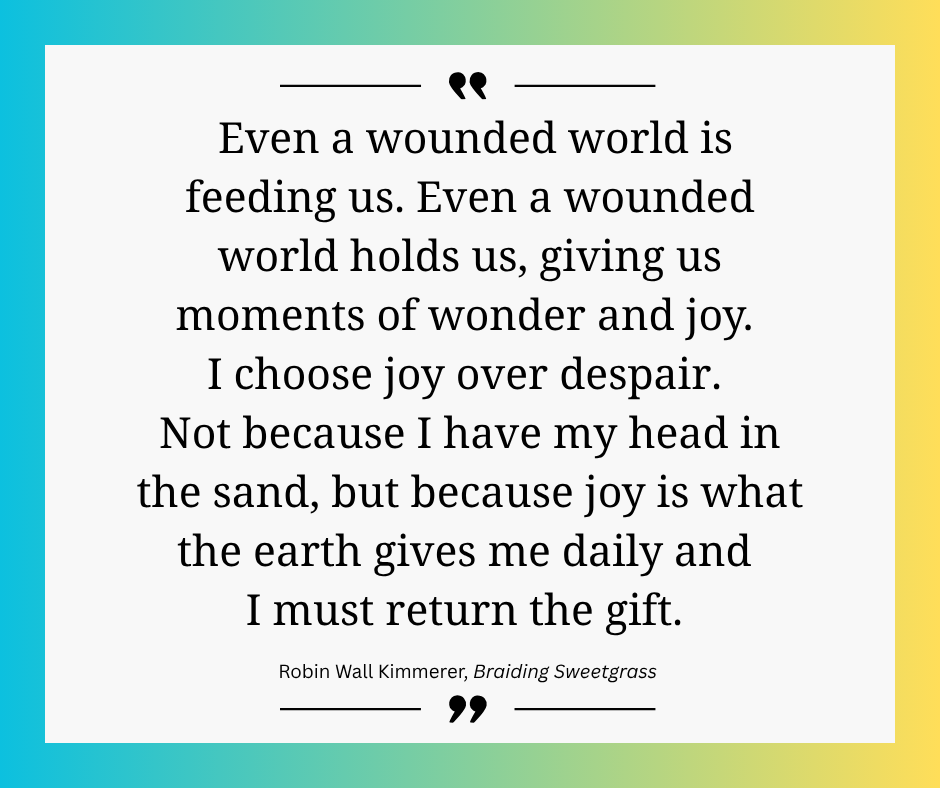
You might think that someone so connected to God’s good creation, so equipped to understand everything about the climate crisis, would be full of despair, but Kimmerer is hopeful and her hope is contagious. She writes, “Even a wounded world is feeding us. Even a wounded world holds us, giving us moments of wonder and joy. I choose joy over despair. Not because I have my head in the sand, but because joy is what the earth gives me daily and I must return the gift” (Braiding Sweetgrass).
The church is also listening and being hopeful. The Consultation on Common Texts (CCT), the people who adjust the Revised Common Lectionary so many of our congregations still use, met in April and adopted a report from a subcommittee of members that had been serving on an ecumenical working group seeking to create a new festival in the church calendar celebrating God’s role in creation. The proposal is for the designation of September 1, or the Sunday following September 1 as the date for the festival, the adoption of the name Festival of Creation in Christ (or the Feast of Creation), and a proposed three-year rotation of lessons. The CCT commended these three proposals to member churches for a three-year period of trial use (2026-2028). Trial use is typically followed by feedback from member churches, alterations as needed, and a CCT recommendation for permanent adoption by member churches, including the ELCA.
What would it look like for those of us steeped in the biblical story, freed by God’s love in Christ Jesus, shaped by our prayers to the triune God, to reach out to our Indigenous neighbors and local biologists and ecologists as we prepare for the Festival of Creation this September? I have no concrete answer, simply an invitation. I trust the power of the Holy Spirit to guide your listening and dreaming and planning.
Peace,
Bishop Meggan